
Affordable Housing Inspections: HUD, REAC & Section 8 Compliance
Your federal housing subsidies depend on what an inspector finds on a specific day. TurnKey National helps you walk into that day prepared, and walk out with a score that protects your properties.
What an affordable housing inspection company actually does for you
A failed REAC score means lost subsidies, vacant units, and a remediation scramble.
REAC stands for Real Estate Assessment Center, the HUD division that scores the physical condition of federally assisted housing. When that score drops below the threshold, HUD assistance payments stop. Residents face displacement. Owners face income loss that can stretch for months.
TurnKey National is an affordable housing inspection company built specifically for this environment. We identify deficiencies before inspectors do. We produce documentation that aligns with HUD NSPIRE standards (the National Standards for the Physical Inspection of Real Estate, HUD's current inspection protocol as of 2023). And we execute the repairs ourselves.
No handoff to a second contractor. No re-scoping from scratch. One company handles the assessment and the fix.
That continuity matters more than most housing providers realize. When the contractor who found the deficiency is the same one remedying it, documentation stays consistent, timelines compress, and the housing authority gets a cleaner file.
Philadelphia is home to one of the nation's largest PHAs. We work in that environment every day.
TurnKey National operates from Philadelphia, headquarters to one of the country's most active public housing authorities.
The Philadelphia Housing Authority (the PHA, or Public Housing Authority, meaning the local government agency that administers HUD programs and oversees compliance) manages tens of thousands of federally assisted units. That density creates a regulatory environment unlike most mid-sized cities. Philadelphia landlords, nonprofit developers, and property managers navigate L&I enforcement, HQS requirements, and REAC cycles simultaneously.
That's the baseline we work from. It's not theoretical knowledge. It's the compliance landscape we operate inside every week.
From that Philadelphia base, TurnKey National deploys 30+ crews across all 50 states. The Mid-Atlantic region (Pennsylvania, New Jersey, Delaware, Maryland, New York) carries an especially heavy concentration of federally subsidized housing stock. Older building inventory, pre-1950 construction in many portfolios, and active Section 8 programs across every county in the region mean our teams work these compliance cycles constantly.
Mid-Atlantic focus
Philadelphia baseHeavy subsidized stockCrews deployed nationallyThat local knowledge shapes how we scope pre-inspection work.
How a REAC preparation engagement actually runs
Every REAC preparation project starts with one goal: close every deficiency before the inspector walks through.
Calling us two weeks before a scheduled REAC inspection produces a very different outcome than calling two weeks after a failed one. The difference in outcomes is significant, and so is the difference in cost. REAC preparation is a sequenced process. Here's how TurnKey National runs it.
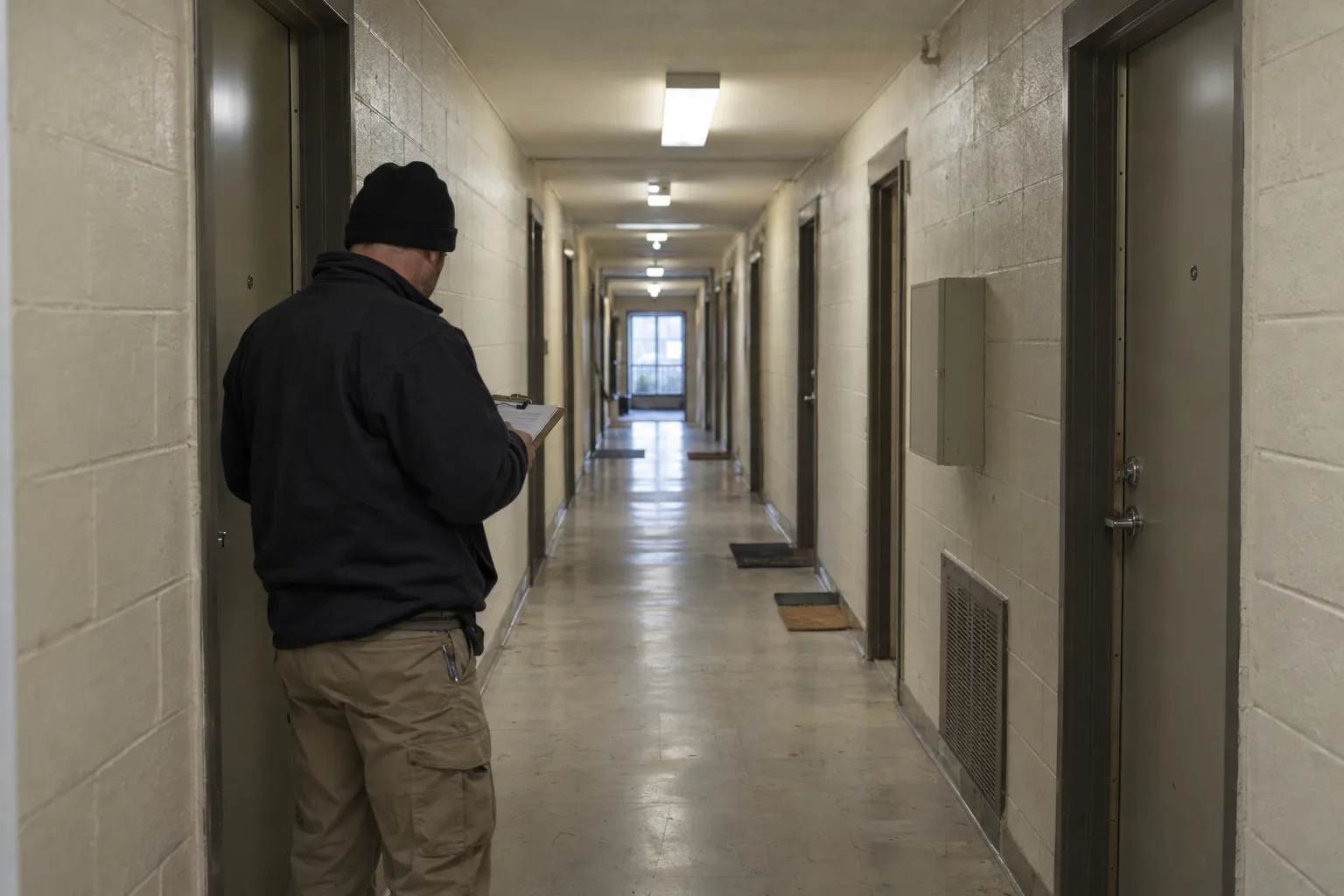
Our team conducts a full interior and exterior assessment using HUD's NSPIRE deficiency classification framework: the scoring system that categorizes findings by severity. Level 1 deficiencies are life-threatening. Level 2 are significant. Level 3 are moderate. Each category carries proportional point deductions. We score the property ourselves before HUD does, using the same criteria.
Not every deficiency costs the same number of points. We rank findings by point impact, not just severity. A Level 2 deficiency in a mechanical room affects the score differently than the same classification in a dwelling unit. We prioritize based on score protection, not remediation ease alone.
We develop a written remediation scope tied directly to the deficiency list. Every item maps to a specific NSPIRE finding category. This isn't a general repair list. It's a compliance document. Our crews execute against that scope with the inspection timeline driving the schedule.
Before the HUD inspector arrives, we produce a pre-inspection documentation package. It includes completed-repair evidence, photo documentation by unit and system, and a summary formatted for housing authority review.
One property we prepared had accumulated 14 separate Level 2 deficiencies (primarily mechanical and egress-related) after years of deferred maintenance. Two of those 14 were in units with active Section 8 tenants. Under the Section 8 / Housing Choice Voucher Program (the federal rental assistance program requiring units to meet Housing Quality Standards before voucher payments apply), those two units were at risk of payment suspension independent of the REAC cycle. We remediated all 14 deficiencies and both HQS-specific items within 19 days. The REAC inspection that followed produced a score above the passing threshold.
That's the outcome that matters: a number that protects your program eligibility.
ISO 9001 certification means our inspection process is audited, not just promised
ISO certification in construction means documented, audited systems, not a badge on a website.
Housing authority procurement staff and nonprofit housing developers ask the right question: "How do we know your process is consistent across every property and every state?" We answer that question with documentation.
ISO 9001 certification means TurnKey National operates under a quality management system that has been independently audited and certified. Standardized procedures, documented processes, and audit trails aren't optional for us. They're built into how we work.
For affordable housing inspections, that matters in a specific way. LIHTC properties (those financed through the Low Income Housing Tax Credit program, which finances affordable housing development and requires physical compliance throughout the compliance period) face ongoing asset preservation obligations. A LIHTC syndicator or tax credit investor needs more than a verbal assurance that work was done correctly. They need a documented scope, a completed-work record, and evidence that the contractor operates to a verifiable standard.
Our ISO-certified process produces exactly that.
Our standards for affordable housing inspection work
TurnKey National holds itself to federal compliance standards, not general contractor benchmarks. Every affordable housing inspection engagement runs under these operating standards:
NSPIRE Alignment
All pre-inspection assessments use HUD's current NSPIRE deficiency categories, not legacy UPCS criteria that housing authorities no longer use for scoring.
Severity-Weighted Prioritization
Deficiencies are ranked by point impact under REAC scoring methodology (Level 1 through Level 3) before remediation sequencing begins.
HQS-Specific Documentation
Section 8 units receive separate documentation structured for local housing authority HQS review, distinct from REAC reporting.
ISO 9001-Certified Process Controls
Every scope, every photo log, every completion record runs through our certified quality management system.
Single-Vendor Continuity
Inspection findings feed directly into remediation scope: no scope translation loss between contractors.
LIHTC Compliance Awareness
Capital improvement scopes for tax credit properties are reviewed against compliance-period preservation obligations before work begins.
30+ Crews, Nationwide Coverage
Remediation capacity across all 50 states means inspection findings can be addressed without geographic delay.
Our execution protocol: inspection through remediation
Diagnostics
We score your property using the same framework HUD inspectors use, before they do.
Every engagement begins with a full NSPIRE-aligned property walkthrough. Our team documents deficiencies by unit, by system, and by severity classification. We note the specific NSPIRE deficiency category for each finding: not a general description, but the precise classification that determines point deduction.
We also flag HQS-specific conditions in occupied Section 8 units separately. HQS requirements (the minimum habitability and safety conditions a unit must meet for voucher payments to apply) can trigger payment suspension on a shorter timeline than REAC cycles. Identifying those conditions at the diagnostic stage protects rental income while the broader REAC preparation proceeds.
Implementation
Remediation executes in deficiency-priority order, not by unit number or convenience.
Our crews work from the written remediation scope tied to the diagnostic deficiency register. High-impact deficiencies go first. Life-safety items are addressed immediately regardless of scheduling sequence.
For properties with active tenants (common in Section 8 and public housing portfolios), our crews coordinate work access to minimize disruption. Coordination happens before crews arrive on-site, not during the work.
Post-Service Testing and Documentation
Every remediated deficiency gets verification before the inspector walks the property.
Post-remediation verification is a structured re-assessment against the original deficiency register, not a walkthrough. Each item on the list gets a documented pass or fail against the NSPIRE standard it originally violated.
Mechanical systems get functional testing. Egress routes get clear-path verification. Life-safety systems (smoke detectors, CO alarms, emergency lighting) get tested against applicable standards with results recorded.
Areas we serve
TurnKey National serves affordable housing providers across all 50 states.
Our Philadelphia base gives us deep operational roots in Pennsylvania, New Jersey, Delaware, Maryland, and New York: states with heavily concentrated federally subsidized housing portfolios. We deploy crews nationally to serve housing authorities, nonprofit housing developers, LIHTC syndicators, and Section 8 landlords wherever their properties are located.
Contact us to confirm crew availability in your state and discuss your inspection timeline.
Frequently asked questions
Anything else goes faster on a call. 610-890-6975
Pricing for REAC preparation depends on property size, unit count, deficiency volume, and state location. Contact TurnKey National at 610-890-6975 with your property details and inspection date for an accurate scope and estimate.
Call at least 30 days before your inspection date. Earlier contact gives crews time to complete a full NSPIRE-aligned walkthrough, triage deficiencies by point impact, execute repairs, and deliver a pre-inspection documentation package. Two weeks is workable. Two days is not. The earlier you call, the more score points we can protect.
TurnKey National is both inspector and repair contractor, with no handoff between firms. Standard inspectors identify deficiencies and hand you a report. We identify deficiencies, prioritize them by REAC point impact, execute the repairs, and deliver documentation formatted for housing authority review. Our process runs under an ISO 9001-certified quality management system that most inspection firms cannot match.
Yes. Section 8 HQS deficiencies in occupied units receive separate documentation scoped for local housing authority review. HQS failures can suspend voucher payments faster than a REAC cycle triggers subsidy loss. We flag and address HQS-specific conditions at the diagnostic stage to protect rental income independently of the broader REAC timeline.
TurnKey National deploys 30+ crews across all 50 states. Philadelphia is our home base, but we serve housing authorities, LIHTC syndicators, and Section 8 landlords nationwide. Contact us with your state, property count, and inspection schedule. We confirm crew availability before scoping begins, so there are no geographic surprises.
Every engagement closes with a pre-inspection documentation package. It includes the original deficiency register, completed-repair evidence, a photo log organized by unit and system, and a written summary formatted for housing authority review. Each remediated deficiency is verified against its specific NSPIRE standard before the package is finalized: not a general walkthrough, a line-by-line confirmation.