

Disaster Restoration Contractor:
A Homeowner's Guide
After a flood or fire, the contractor you choose determines how fast you recover and whether your insurance claim holds up. This guide explains how restoration works, what to watch for, and how to avoid costly mistakes.
National Coverage
All 50 States
About TurnKey National
One Contractor. Every State. Every Trade.
TurnKey National Enterprises LLC was founded in 2020 with a specific goal: give property owners, investors, and housing operators a single ISO-certified contractor who can handle complex, multi-trade projects anywhere in the country.
Most restoration jobs require coordination across multiple trades simultaneously. Structural repairs, HVAC replacement, electrical, roofing, and interior finishing often need to happen in a specific sequence. When you split that work across four separate regional contractors, you own the scheduling risk and the coordination gaps. TurnKey manages the entire sequence under one contract.
The firm works across residential, commercial, hotel, and HUD-regulated affordable housing. Projects range from single-family disaster restoration to full gut renovations of multifamily properties requiring strict HUD REAC and UPCS compliance. Learn more on the TurnKey National About page.
Talk to a Project Manager →ISO Certified
Quality management standards applied to every project, regardless of size or state.
HUD / REAC / UPCS
Deep regulatory knowledge for federally-regulated housing projects. Not every contractor understands these frameworks. TurnKey does.
Lender-Ready
Draw schedules, escrow management, and documentation structured to meet lender requirements from day one.
Since 2020
Built for the national market from the start, not a regional firm trying to scale.
What We Cover
Disaster Restoration: What Actually Happens After the Event
Step 1: Damage Assessment
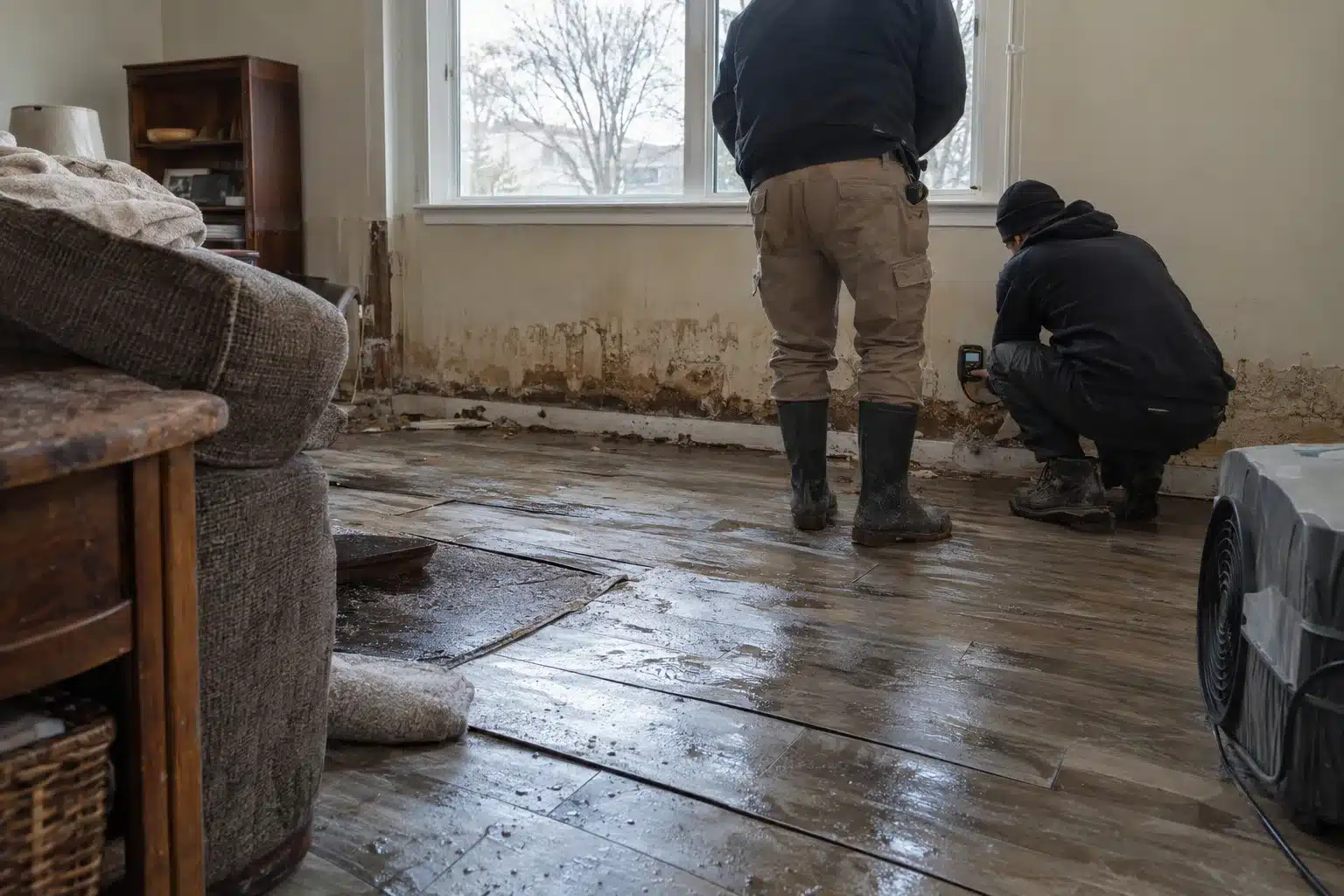
The first 24 to 48 hours after a flood or fire are the most important. A qualified restoration contractor documents scope before any cleanup begins. Photos, moisture readings, and structural notes form the foundation of your insurance claim. Skip this step and you lose leverage with the adjuster.
TurnKey's assessment process follows the documentation standards that insurers and HUD reviewers expect. That matters especially for properties under federally-assisted programs, where incomplete records can trigger compliance issues on top of the physical damage.
Step 2: Mitigation and Containment
Mitigation means stopping the damage from getting worse. For water damage, that typically means water extraction, industrial drying, and controlled demolition of saturated materials within 48 to 72 hours to prevent mold. For fire damage, it means tarping, board-up, and smoke containment before structural work begins.
These first-response steps are time-sensitive. Drywall, subfloor, and insulation that stays wet past 72 hours almost always requires full replacement rather than drying. Acting fast reduces total project cost significantly.
Step 3: Structural Repairs and Trade Coordination
Once mitigation is complete and the insurance adjuster has reviewed the site, reconstruction begins. This is where multi-trade coordination matters most. Framing, HVAC, electrical, plumbing, roofing, and drywall all have sequencing dependencies. If the HVAC subcontractor shows up before the rough framing is signed off, the job stops.
TurnKey manages this directly. Flood and fire restoration services include structural, mechanical, and finish trades under one project manager. You get one point of contact, not a group chat with four contractors.
Step 4: Pre-1978 Properties and Lead Regulations
If your home was built before 1978, federal lead-safe work practice rules apply to any renovation, repair, or painting job that disturbs lead-based paint. This is not optional. The EPA's Lead Renovation, Repair and Painting Rule requires contractors to follow specific containment and cleanup protocols.
Many restoration contractors skip proper lead protocols during emergency work, creating liability for the property owner after the fact. TurnKey's pre-1978 property renovation process accounts for these requirements from day one.
Working With Your Insurance Adjuster
Your insurance adjuster works for the insurer. That does not make them adversarial, but it does mean their scope estimate may not match what full restoration actually requires. A contractor experienced in insurance claims will identify items the adjuster missed and submit a supplemental estimate.
Common gaps in initial adjuster estimates include hidden moisture damage behind walls, code-upgrade requirements triggered by the renovation, HVAC replacement when the original unit was already marginal, and full cabinet replacements when only partial damage is initially noted.
Review TurnKey's full Disaster Restoration and Insurance Claims Guide for a detailed breakdown of how to document and negotiate your claim.
What your adjuster's estimate often misses:
- ✓ Hidden moisture behind intact finishes not visible during initial walkthrough
- ✓ Code-required upgrades triggered when more than a threshold percentage of a system is replaced
- ✓ HVAC systems that cannot be dried and reinstalled safely after flood exposure
- ✓ Lead or asbestos testing and abatement required before work can proceed
- ✓ Temporary housing and storage costs that may be covered under your policy
Restoration for HUD-Regulated and Affordable Housing Properties
Disaster damage to a HUD-regulated property triggers a separate compliance layer on top of the standard restoration process. The property must be brought back into UPCS compliance, not just repaired to pre-loss condition. Those are not the same standard.
REAC inspectors use the Uniform Physical Condition Standards, which have specific thresholds for structural systems, site conditions, building exterior, common areas, and units. A fire that damages roof framing in an affordable housing complex does not just need a new roof. It needs a roof that will pass the next REAC inspection.
TurnKey's team understands HUD REAC and UPCS inspection standards and builds those requirements into the restoration scope. That protects property owners and housing authorities from failing the next inspection after an already stressful event.
For more on preparing for a REAC inspection, the HUD Real Estate Assessment Center publishes current scoring guidelines.
Escrow and Draw Management After a Disaster
Lenders and insurers releasing restoration funds in draws need inspection checkpoints before each disbursement. A contractor who cannot produce accurate draw documentation delays your funding, which delays the project.
TurnKey's escrow inspection and draw management services are structured specifically for this. Progress documentation, milestone sign-offs, and inspection reports are produced in formats that lenders accept without revision requests. See also: renovation contractor lender requirements.
Choosing a Restoration Contractor: What to Verify
Licensing and Insurance
Verify the contractor holds a valid general contractor license in your state. Ask for certificates of liability insurance and workers' compensation before signing anything. Most states publish license lookup tools online. No license, no contract.
Direct Hire vs. Subcontracting
Ask who will actually do the work. Contractors who immediately sub out every trade have less control over quality and scheduling. Understand the chain before the project starts, not after something goes wrong.
Assignment of Benefits
Some contractors pressure homeowners to sign Assignment of Benefits agreements immediately, which transfers your insurance claim rights to them. Several states restrict or ban this practice. Read any document carefully before signing, and consult your insurer or a public adjuster if you have questions.
Written Scope Before Work Begins
A line-item written scope of work protects you. It makes change orders transparent and gives you a basis for comparing the final work to what was agreed. Verbal commitments are unenforceable. Get everything in writing.
Payment Schedule
Avoid contractors who demand more than 10 to 15 percent upfront on residential jobs. Payments should be tied to verified milestones, not arbitrary dates. A contractor who needs large advance payments before starting work is a warning sign.
Experience with Your Damage Type
Fire damage and flood damage require different protocols. A contractor strong in one area may not have the right equipment or drying methodology for the other. Ask for specific examples of similar past projects, not just general experience claims.
National Vendor vs. Multiple Regional Contractors
If you manage properties in more than one state, the case for a national vendor is straightforward. You get consistent documentation, consistent quality standards, and one contract rather than separate agreements with contractors in each market.
The downside of using multiple regional contractors is coordination overhead. Each contractor has different billing formats, different documentation standards, and different communication habits. On a simple single-family restoration, that is manageable. On a portfolio of properties across multiple states after a named storm, it is not.
Read the full breakdown: National vendor vs. multiple contractors.
Is a national construction vendor worth it? →TurnKey's Full Service Portfolio
Disaster restoration is one part of what TurnKey handles nationally. The full service range covers the complete lifecycle of a property.
For compliance-specific resources, see TurnKey's guides on UPCS inspection compliance, the renovation inspection pricing guide, and what happens if you fail a Section 8 inspection. For general contractor industry standards, NAHB (National Association of Home Builders) publishes residential construction benchmarks.
Serving All 50 States
Ready to Talk About Your Project?
Whether you have an active disaster claim, a property portfolio that needs a reliable contractor across multiple states, or a compliance requirement you need to resolve before the next REAC inspection, TurnKey can scope it.
Initial project assessments are straightforward. You describe the property, the scope, and the timeline. TurnKey provides a clear plan of approach with no obligation.
National Coverage
Projects in any U.S. state handled under a single contract and single point of contact.
Multi-Trade Coordination
Structural, mechanical, roofing, and finish trades coordinated by TurnKey project managers, not handed off to strangers.
Compliance-Ready Documentation
Insurance, lender, HUD, and REAC documentation produced to standard on every project. Visit the TurnKey blog for more resources.
ISO Certified Since 2020
Quality management certification applied to process and documentation standards across every project type. See our FAQ for common questions.
© 2026 TurnKey National Enterprises LLC. All rights reserved.